
Microcement vs micro concrete
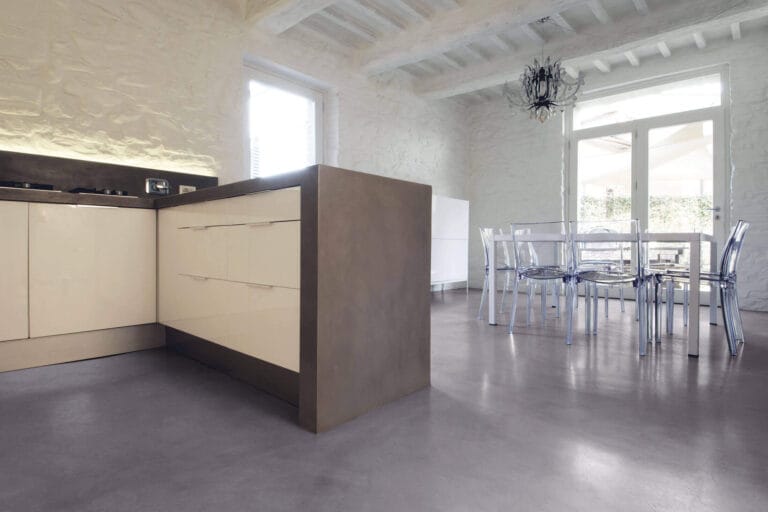
Microcement and micro concrete sound alike, and both make decorative, hard-wearing surfaces. The difference is thickness: microcement is a thin, seamless finish that transforms floors, walls and worktops without raising the floor.
Need advice?01472 240 340
Request a quote
The short answer
No, microcement and micro concrete aren’t the same, but it’s easy to see why people mix them up. Both are concrete-based products you apply to floors and walls for a decorative, hard-wearing finish.
The difference is how thick they go on, and so what they’re used for.
At a glance
- Microcement
- About 2–3 mm in total
- Micro concrete
- From 2–3 mm up to 50 mm
- Microcement is
- A cosmetic finish over a solid base
- Micro concrete is
- Used for repairs and decorative coatings
Why choose microcement
Our pick: Politura or ErreLAB
If you want a decorative finish rather than a repair, microcement is the one to choose, and we recommend two systems.
Politura is traditional mineral microcement, with natural depth and movement, for indoor floors, walls and worktops, including bathrooms away from direct water.
ErreLAB (Spatolato, Velato, Pietra Continua and Metallo Continuo) are resin systems made to mimic traditional microcement, stone and metallic finishes, but with better performance: harder wearing, more stain resistant and waterproof at every layer, so they can go anywhere indoors, including showers. Outside, use Spatolato Outdoor or Pietra Continua Outdoor.
At a glance
- Politura
- Traditional mineral microcement, 2–3 days
- ErreLAB
- Epoxy resin finishes, 4–5 days
- Showers
- ErreLAB
- Outdoors
- Spatolato Outdoor, Pietra Continua Outdoor
- Slip
- Spatolato R10 with Top Clear, up to R11–R12 with Top Clear SOL
Side by side
Both are concrete-based and hard-wearing. The difference is thickness, and so what they’re for.
Thin
Microcement
- Thickness
- 0.8–1 mm per coat, usually 2–3 coats
- Used for
- Decorative floors, walls, worktops and furniture
- Needs
- A solid, smooth base: screed, self-leveller, timber or tiles
- Levelling
- Follows the surface underneath
- Also called
- Micro toppings, micro screeds, and trade names such as Politura
Thick
Micro concrete
- Thickness
- 2–3 mm up to 50 mm
- Used for
- Repairs to steps, pillars and beams, and thicker decorative coatings
- Needs
- Can be pumped into place and shaped with shuttering
- Levelling
- Often self-levelling
- Also called
- Varies by product
Microcement floors, walls and stairs
6 photos
Floors, walls, stairs and bathrooms, each about 2–3 mm thick.
Questions about microcement and micro concrete
Which should I choose?
For a decorative floor, wall or worktop, microcement. Micro concrete is for repairs and thicker coatings. Call our technical team on 01472 240 340 to talk through your project, especially the clearance you have.
Is microcement strong enough for floors?
Yes. Once sealed it’s extremely hard wearing, and ErreLAB is built for busy homes and commercial floors. It needs a solid base, because it follows the surface underneath.
Will microcement hide an uneven floor?
No. The whole coating is only 2–3 mm thick, so the base needs to be solid and smooth first.
Can microcement go over metal or glass?
Some products can, but not all. Check each product’s details before you start.
How is microcement applied?
In thin trowelled coats over a primer, then sealed. See Applying microcement for who it suits and how to learn.
Videos
Mrs Microcement explains what microcement is and how mineral microcement works.
More guides

Floors
What to know about microcement floors, from substrates to sealers.
Read the floors guide →
Walls
Feature walls, kitchens and living spaces, and how to prepare the background.
Read the walls guide →
Bathrooms and wet rooms
Which systems work in showers, wet rooms and on vanity tops.
Read the bathrooms guide →
Commercial spaces
Slip, fire and hygiene data for shops, hotels, restaurants and clinics.
Read the commercial guide →
Over tiles
Cover tiled walls and floors without ripping them out, and the preparation that makes it last.
Read the over tiles guide →
Microcement vs tiles
Seamless or grouted: how they compare, and how microcement can go straight over old tiles.
Read the guide →
Outdoors
Patios, terraces, balconies and pool surrounds in UV-stable ErreLAB resin.
Read the outdoors guide →
Applying microcement
Who it suits, which system is easiest to learn, and how to get good at it.
Read the guide →
Microcement vs polished concrete
A similar seamless concrete style, without pouring a new slab.
Read the guide →
Compare the systems
Politura, ErreFast and ErreLAB side by side: water resistance, speed and where each can go.
Compare them →Get the look without the thickness
Tell us about the space and we’ll recommend the right system, send samples and give you a price.