
Microcement vs polished concrete
Love the look of polished concrete? Microcement gives you a similar seamless, industrial style without pouring and grinding a new slab. It’s a hand-trowelled finish about 2–3 mm thick that goes over the floor you already have, and onto walls, stairs and even showers.
Need advice?01472 240 340
Request a quote
The short answer
Microcement gives you a similar seamless, concrete-style finish at about 2–3 mm, without pouring and grinding a new slab. It goes over the floor you already have, suits upstairs rooms and carries on up walls and stairs. Polished concrete is the slab itself, so it’s floors only, and heavy.
Polished concrete is typically 100 mm or more of concrete, poured, left to cure, then ground and polished with heavy machines. Microcement is trowelled by hand in thin layers, so there’s no new slab, no weeks of curing and no grinding on site.
Politura microcement, our own traditional mineral microcement, is the closest we do to the look of polished concrete, and can be polished without wax. For showers and wet areas, ErreLAB Spatolato gives you the soft, trowelled look of microcement with the toughness of epoxy.
At a glance
- Microcement
- About 2–3 mm, trowelled by hand
- Polished concrete
- A ground and polished slab, typically 100 mm or more
- Walls and stairs
- Microcement, yes. Polished concrete is floors only
- Existing floors
- Microcement goes over them. Polished concrete needs a new slab
Is microcement better than polished concrete?
If you’re renovating, or want the look anywhere other than a ground floor, we think so. Here’s what it gives you.
Is microcement cheaper than polished concrete?
It depends on what’s already there. On a floor you already have, microcement saves the cost of breaking out and pouring a new slab, the curing time and the heavy machinery. On a new build where a slab is being poured anyway, the sums are closer, so it’s worth pricing both.
Microcement cost also depends on which system you choose, so there’s no single price per m². Here’s what moves the price on each side:
| What changes the price | Microcement | Polished concrete |
|---|---|---|
| Materials | Depends on the system: Politura microcement, ErreFast or ErreLAB | The concrete mix, and any added colour or aggregate |
| The floor underneath | Goes over sound concrete, screed and timber once prepared and primed, and over well-bonded tiles with ErreLAB | Needs a new slab, or a thick polished overlay |
| Labour | A skilled, hand-applied finish over 2–5 days, depending on the system | Pouring, curing, then grinding and polishing |
| Machinery | No heavy grinding machines on site | Heavy grinding and polishing machines |
| Other rooms and surfaces | The same finish can carry on up walls and stairs | Floors only, so walls need a separate finish |
Tell us about your floor and we’ll give you a price for the right system.
The closest finish: Politura microcement
Politura microcement is our own traditional mineral microcement, and the closest thing we do to polished concrete. It’s quartz-based, one of the hardest microcements on the market, and hard enough to polish without wax, so you get that polished feel without the upkeep of a waxed floor.
Need it in a wet area? ErreLAB Spatolato is a resin made to mimic traditional microcement: a smooth, trowelled finish with soft, tone-on-tone movement. As an epoxy resin it’s harder wearing and more stain resistant than a mineral microcement, and waterproof at every layer, so it also goes into showers and wet rooms.
Spatolato at a glance
- Type
- Epoxy resin
- Slip
- R10, or R11–R12 with Top Clear SOL
- Fire
- Bfl-s1 (EN 13501-1)
- Colours
- Three ErreLAB charts, plus RAL and NCS matching
- Time
- 4–5 days
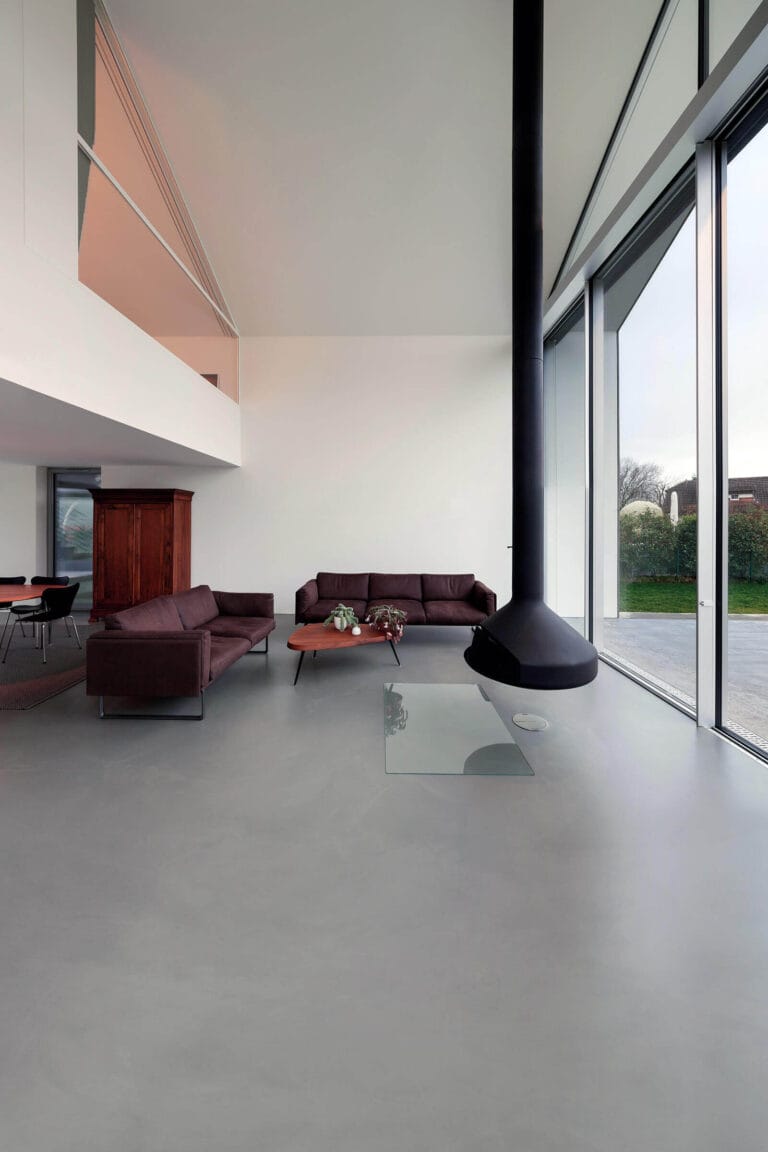
Politura and Spatolato floors
6 photos
Shops, restaurants and homes with Politura and ErreLAB Spatolato floors.
Side by side
Both give a seamless, concrete-style floor. Microcement does it without the slab, and goes much further.
Thin coating
Microcement
- Thickness
- About 2–3 mm in total
- Where it goes
- Floors, walls, stairs, worktops and bathrooms, depending on the system
- Over existing floors
- Yes, with the right primer for what’s underneath, so there’s no new slab to pour
- Weight
- Light, so it suits upstairs floors
- How it’s laid
- Trowelled by hand: Politura and ErreFast in 2–3 days, ErreLAB in 4–5 days
- Look
- Soft, trowelled movement; Politura can be polished to look similar to polished concrete
- Showers and wet rooms
- Yes, with ErreLAB; we also recommend tanking
- Colours
- 27 Politura colours and over 200 ErreLAB colours
- Hard wearing
- Extremely: epoxy resin (ErreLAB) or quartz at Mohs 7 (Politura)
Ground slab
Polished concrete
- Thickness
- The slab itself, typically 100 mm or more
- Where it goes
- Floors only
- Over existing floors
- Needs a new slab or a thick polished overlay
- Weight
- Heavy, so it suits ground floors and new builds
- How it’s laid
- Ground and polished with heavy machines, after the slab has cured
- Look
- Plain grey or exposed stone, depending on how deep it’s ground
- Showers and wet rooms
- No
- Colours
- Mostly natural greys, or a coloured slab
- Hard wearing
- Very, once ground and sealed
Which microcement should you use for the polished concrete look?
| Where | What we’d recommend | Good to know |
|---|---|---|
| Living spaces and hallways | Politura microcement | The closest to polished concrete, polished without wax |
| Upstairs and timber floors | Politura microcement or ErreLAB | At 2–3 mm it suits upper floors, with the right primer |
| Showers and wet rooms | ErreLAB Spatolato | Waterproof at every layer; we also recommend tanking |
| Walls and stairs | The same system as the floor | One continuous finish, which polished concrete can’t do on walls |
| Shops, hotels and restaurants | ErreFast or ErreLAB | See the commercial guide for slip and fire data |
Which lasts longer, microcement or polished concrete?
Both can last for many years when they’re done properly, and our team has worked with microcement since the early 90s.
What decides it is the work you can’t see: a sound floor underneath, careful preparation, the right system for the room and the right sealer. Politura microcement is made from quartz sand at Mohs 7, and ErreLAB’s epoxy resins are extremely hard wearing and stain resistant.
What to get right with microcement
Microcement gives its best when it’s done properly. Here’s what matters most, and how to get each one right.
Questions about microcement and polished concrete
Can microcement look like polished concrete?
It can come close. Politura microcement is the closest we do: it’s a traditional mineral microcement that can be polished without wax for a polished-concrete feel. It comes in 27 colours, including plenty of greys.
Can I have the polished-concrete look upstairs?
Polished concrete is a heavy slab, so it rarely suits upper floors. Microcement is about 2–3 mm, which makes it the practical way to get the look upstairs, and on walls and stairs.
Is microcement as hard wearing as polished concrete?
Yes, for homes and busy commercial floors. Politura microcement is made from quartz sand at Mohs 7, one of the hardest microcements on the market, and scratch resistant to a steel file. ErreLAB Spatolato is an epoxy resin built for heavy use, stain resistant and waterproof at every layer.
Does it work with underfloor heating?
Yes. Run new underfloor heating for at least 28 days, then switch it off before starting.
Which should I choose?
If you’re renovating, want the look upstairs, or want it on walls and stairs too, choose microcement. Call our technical team on 01472 240 340 and we’ll help you pick the right system.
Is microcement the same as polished concrete?
No. Polished concrete is a thick slab that’s ground and polished. Microcement is a thin, hand-trowelled finish of about 2–3 mm that goes over an existing surface, and can look similar.
Is microcement cheaper than polished concrete?
On an existing floor it can save the cost of a new slab, the curing time and the heavy machinery. The price depends on the system and the floor underneath, so ask us for a price.
Will microcement crack like concrete?
The products themselves are designed not to crack, but cracks or movement in the floor underneath can show through. Repair cracks and carry movement joints through the finish.
Can I use it on stairs and walls?
Yes. Microcement can run across floors, walls and stairs as one finish, whereas polished concrete is floors only.
Videos
Mineral microcement explained, and how ErreLAB stands up to stains.
More guides

Floors
What to know about microcement floors, from substrates to sealers.
Read the floors guide →
Walls
Feature walls, kitchens and living spaces, and how to prepare the background.
Read the walls guide →
Bathrooms and wet rooms
Which systems work in showers, wet rooms and on vanity tops.
Read the bathrooms guide →
Commercial spaces
Slip, fire and hygiene data for shops, hotels, restaurants and clinics.
Read the commercial guide →
Over tiles
Cover tiled walls and floors without ripping them out, and the preparation that makes it last.
Read the over tiles guide →
Microcement vs tiles
Seamless or grouted: how they compare, and how microcement can go over old tiles.
Read the guide →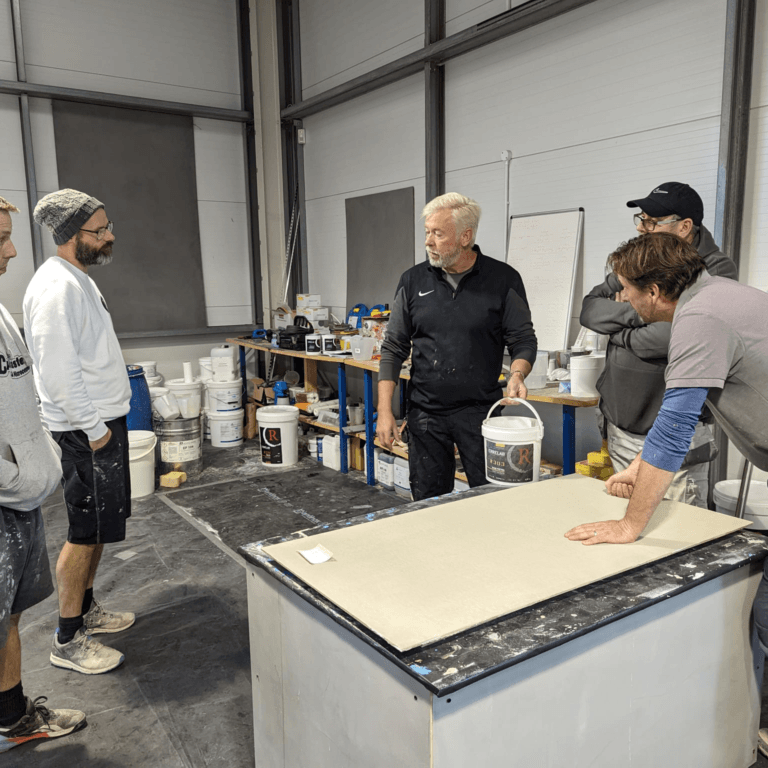
Applying microcement
Who it suits, which system is easiest to learn, and how to get good at it.
Read the guide →
Microcement vs micro concrete
They sound alike but aren’t the same. The difference is thickness.
Read the guide →
Compare the systems
Politura, ErreFast and ErreLAB side by side: water resistance, speed and where each can go.
Compare them →The modern concrete look, without the slab
Tell us about your floor and we’ll recommend the right system and send you samples.